
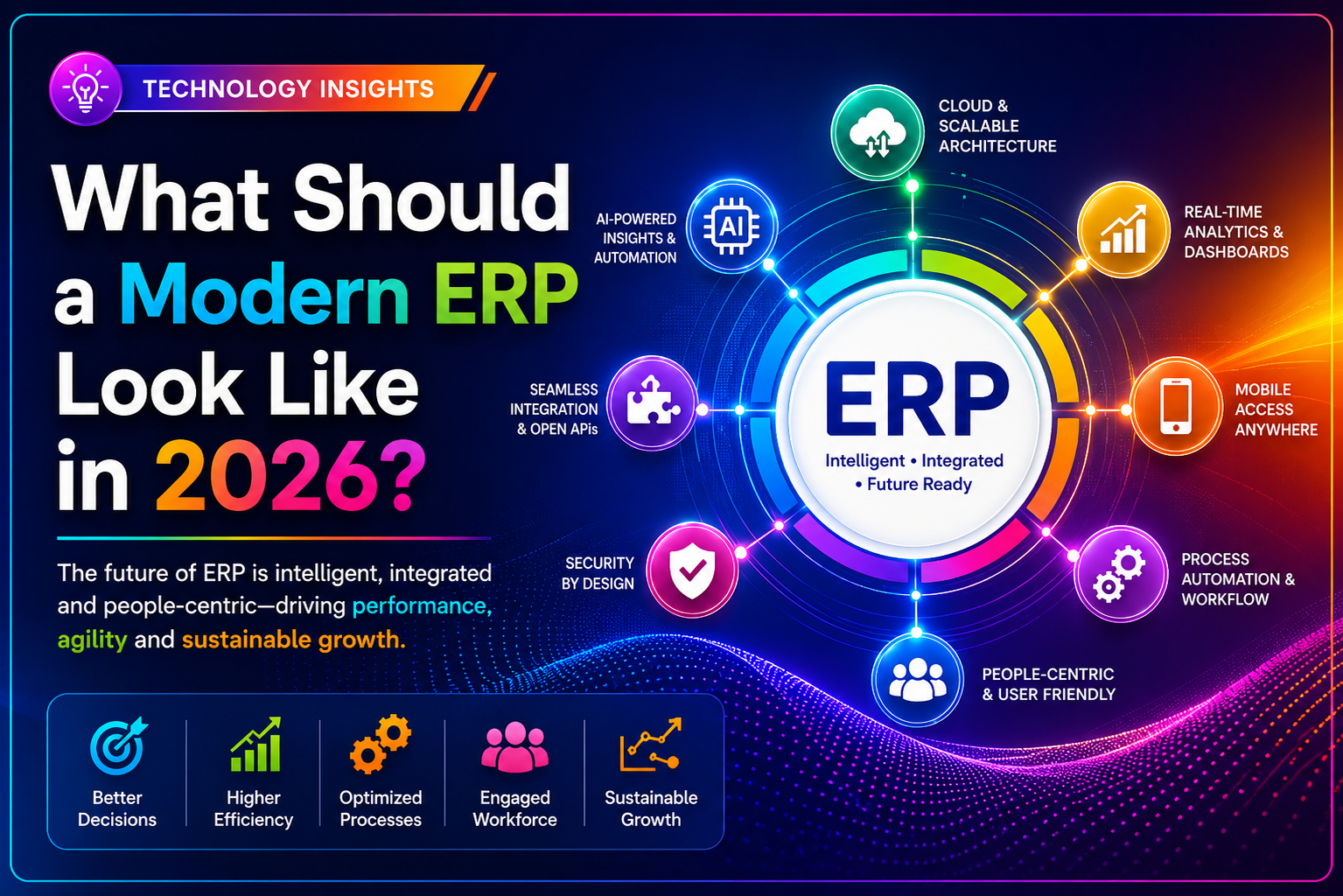
What Should a Modern ERP Look Like in 2026?
What Should a Modern ERP Look Like in 2026?
Moving Beyond Traditional ERP to Intelligent Enterprise Platforms
Enterprise Resource Planning (ERP) has evolved significantly. In the past, ERP was primarily about bringing accounting, inventory, procurement, HR, sales, and other business functions into one system.
In 2026, that is no longer enough.
A modern ERP should become the digital backbone of an organization—connecting people, processes, data, applications, and decision-making through one intelligent and scalable platform.
At Opus Technology Limited, our experience with ERP implementation, including ELPIDA ERP, reinforces an important lesson: successful ERP is not simply about installing software. It is about creating a connected operating environment that continuously improves business performance.
1. Integrated by Design
Modern organizations cannot afford disconnected systems and isolated data.
A contemporary ERP should provide seamless integration across:
Finance & Accounting
Procurement
Inventory & Warehouse
Sales & Distribution
HR & Payroll
Project & Task Management
Asset Management
Manufacturing and Operations
Reporting & Business Intelligence
ELPIDA ERP, developed by Opus Technology, is designed as a unified platform that connects key business operations and enables data to flow across departments.
2. Real-Time Data, Not Delayed Reports
A modern ERP should help management understand what is happening now, not what happened weeks ago.
Real-time dashboards, management reports, financial visibility, operational KPIs, and business intelligence allow decision-makers to respond faster and make decisions based on current information.
The value of ERP increasingly comes from turning enterprise data into actionable insight.
3. AI-Ready and Intelligent
The next generation of ERP is moving from automation toward intelligence.
AI can support organizations through:
Intelligent data analysis
Predictive insights
Automated workflows
Exception detection
Smart recommendations
Natural-language interaction
Improved forecasting and planning
Opus Technology is already positioning AI as a core part of modern software architecture, with a focus on smarter automation, predictive insights, and intelligent digital solutions.
4. Flexible APIs and Ecosystem Integration
ERP should not operate as a closed system.
Modern enterprises need ERP platforms that can integrate with:
Banks • Payment Platforms • Government Systems • E-commerce • CRM • Mobile Applications • HR Platforms • BI Tools • Third-Party APIs
API-driven integration enables organizations to build an ecosystem around ERP rather than replacing every existing digital system.
5. Cloud, Scalability and Accessibility
Business operations are no longer limited to a single office.
A modern ERP should support secure access across locations, branches, and devices while allowing organizations to scale as their business grows.
The right architecture should make it easier to add users, branches, transactions, modules, and integrations without creating unnecessary complexity.
6. Security Must Be Built In
Modern ERP manages highly sensitive financial, operational, employee, and business information.
Security should therefore be embedded across the platform through appropriate access controls, authentication, authorization, audit trails, secure data handling, monitoring, and infrastructure protection.
For organizations, security is not an optional ERP feature—it is a business requirement.
7. Designed Around People and Processes
Technology alone does not guarantee ERP success.
Opus Technology's practical ERP experience highlights the importance of stakeholder alignment, implementation planning, user adoption, training, governance, and continuous improvement.
A modern ERP should therefore be:
People-centric + Process-driven + Technology-enabled
The objective is not to force every organization into the same workflow. The objective is to improve processes while avoiding unnecessary customization and complexity.
8. Continuous Improvement After Go-Live
ERP implementation should not be considered the finish line.
After deployment, organizations should continuously evaluate:
What can be automated?
What can be integrated?
What data can provide better insight?
Which workflows can be optimized?
What do users need next?
This continuous improvement mindset is essential for achieving long-term ERP value.
The Opus Technology Perspective
At Opus Technology Limited, we believe the future of ERP is not simply more modules.
It is about creating an intelligent enterprise platform that brings together:
Integration + Automation + AI + Real-Time Analytics + Security + Scalability
Our ELPIDA ERP approach is built around unified business operations, process automation, seamless data flow, and improved organizational efficiency.
The Future of ERP Is Intelligent
Organizations should no longer ask:
“Which ERP software should we buy?”
The more important question is:
“How can our ERP become the digital backbone of our business?”
In 2026, the answer lies in choosing a platform that can evolve with the organization—supporting today's operations while creating a foundation for tomorrow's automation, intelligence, and growth.
Opus Technology Limited — Building intelligent enterprise solutions for a connected future.
#ERP #EnterpriseTechnology #DigitalTransformation #AI #BusinessIntelligence #Automation #CloudERP #OPUSTechnology #ELPIDAERP

0 Comments